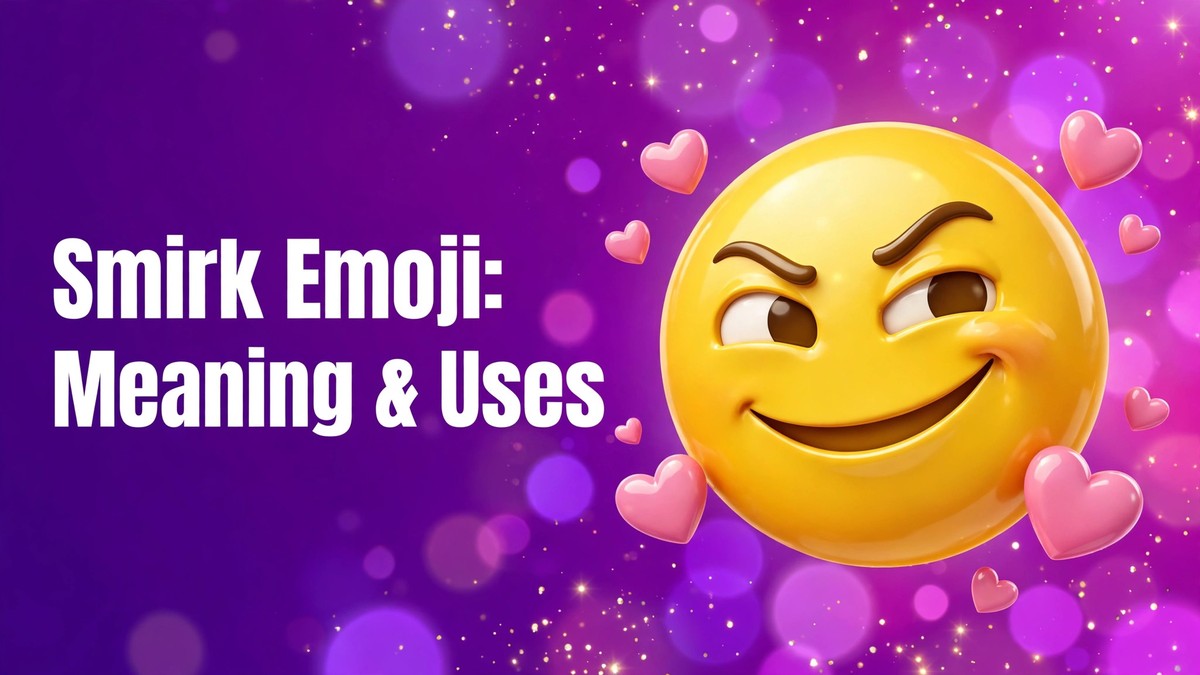
Smirk Emoji 😏 Meaning, Uses & Copy-Paste Guide
A half smile, a sideways glance, and eyes that say the sender knows something you do not: the 😏 smirk emoji is the most misread face on your keyboard. It can mean a flirty hint, a smug win, a sly joke, or a quiet “I told you so,” and the difference is always in the message around it.
This guide covers what the smirk emoji really means, its flirty, smug, and teasing uses, real chat examples, lookalike comparisons, copy-paste combos, and the moments when a smirk can backfire. Once you learn to read the half smile, you will know exactly when to smirk back and when to stay quiet.
Unicode: U+1F60F · Official name: Smirking Face · Also called: smirk, smug face, sly face · Category: Smileys & Emotion · Added in Unicode 6.0 (2010), Emoji 1.0 (2015)
What does 😏 mean in texting?
- “I know something you do not.” The core meaning: a knowing look that says the sender is holding back a thought, a secret, or a piece of news. A smirk after a hint, a half told story, or a claim nobody can prove yet tells the reader there is more to the story, so 😏 works like a raised eyebrow in text form, and it invites the other person to ask what is going on.
- Flirty hint. The second meaning is playful and suggestive: a compliment with a smirk, a late night text with a smirk, or a “you looked good today” that ends with 😏. Here the emoji says the message has a second layer, and it opens the door to flirting without saying anything direct, so the sender can deny the flirt if the reply is cold.
- Smug pride. The third meaning is quiet victory: “I was right,” “I called it,” or “look who won the bet.” A smirk after a correct prediction, a won game, or a clever comeback says the sender is pleased with themselves, and it does it with a grin instead of a boast, which makes the win feel playful instead of rude.
The smirk reading works because the gesture is so old. A smirk is a smile that is a little too pleased with itself, and the word itself goes back centuries in English for exactly that look: a smile with smugness or quiet triumph behind it. 😏 is the digital version of that same face: one corner of the mouth lifted, eyes half closed, and a message that says “I know more than I am saying.” That history is why the emoji feels natural to everyone, from teens to grandparents, even though each generation uses it a little differently.
Context decides everything with 😏. After “I told you so” it means smug pride. After “you looked great tonight” it means flirting. After “guess what happened” it means a secret is coming. The same face can tease a friend, test a crush, or celebrate a win, so always read the sentence around it before you decide what the sender meant. A smirk never changes the words, but it changes how every word is heard, which is exactly why it is so easy to misread.
What 😏 means by who sends it
From a friend, 😏 almost always means teasing or an inside joke. Friends use it to mark a prediction that came true, to recall a shared memory, or to hint at a secret the group knows. If your best friend sends “told you she would say yes 😏” after your crush finally replies, the smirk is the whole joke: it says “I knew it all along, and we both know it.”
From a crush, 😏 usually means flirting. It turns an ordinary compliment or a casual plan into something with a second meaning, and it does it gently, so the sender can deny the flirt if the reply is cold. The smirk is a low risk way to test the waters: if you flirt back, the game is on, and if you laugh it off, nothing was ever said. A smirk from a crush is one of the clearest signs that the conversation is moving past friendly.
From a parent or an older relative, 😏 usually means a proud tease or a gentle “I told you so.” Parents use it after a prediction comes true, after you finally admit they were right, or to joke about a childhood story. The flirty reading almost never applies here, which is a useful reminder that the sender matters as much as the symbol: the same smirk means something completely different depending on who is behind it.
How to reply when someone sends 😏
The best reply matches the game the smirk started. If it was a joke, laugh and play along. If it was a flirt and you like it, smirk back. If it was a secret, ask what they know. If it felt smug, a light roast keeps the tone friendly. Here are four replies that fit most 😏 messages:
“Oh really? Spill it, I know that face 😏”
“Okay, you were right this time, enjoy it 😂”
“You look way too proud of yourself right now 😏”
“Haha, smooth. Tell me more 😉”
A good rule is to let the smirk do the work and keep your words simple. One 😏 back says “message received, game on” without overcommitting, while a flood of smirks turns a light tease into something heavier than the sender meant. If the smirk followed a joke, a laughing reply keeps the friendship warm. If it followed a flirty hint and you are not interested, a friendly but plain reply is the cleanest way to close the door gently.
Examples of 😏 in real chats
Teasing a friend who called it right
Friend: I told you the test would be easy
You: You guessed one question right, calm down
Friend: One? I called the whole paper 😏
You: Okay genius, help me study next time then
This is the classic 😏 move: a smug little victory lap after a prediction comes true. The emoji tells your friend you are proud, not angry, and the reply can be as dramatic as you like because everyone knows it is play.
Flirting after a compliment
Friend: You looked really good in that photo
You: Oh stop, you are just saying that
Friend: Am I? 😏
You: Okay fine, thank you, you looked pretty good too 😊
Here 😏 turns a simple compliment into a flirty hint. The smirk adds the second meaning, and the conversation stays light because both people are clearly enjoying the game.
Gloating after winning a bet
Friend: No way my team loses tonight
You: Ten bucks says they do
Friend: Deal
You: Pay up 😏
After a won bet, 😏 says “I knew it, and you knew I knew it.” It turns a small win into a shared joke, which is why the smirk is the natural closer for a friendly bet.
😏 vs 😉 vs 😈: what is the difference?
| Emoji | Meaning | Vibe |
|---|---|---|
| 😏 | Smirking face, a knowing look with a hidden meaning | Sly, smug, suggestive |
| 😉 | Winking face, a joke, a hint, or a shared secret | Playful, friendly, light |
| 😈 | Smiling face with horns, playful mischief and trouble | Cheeky, bold, mischievous |
Think of it this way: 😏 is the smirk that says “I know something you do not,” 😉 is the wink that says “I am joking,” and 😈 is the grin that says “I am up to something.” The mix-up is common because all three are playful, but only 😏 carries the smug edge, only 😉 works as a general purpose joke marker, and only 😈 brings the mischief. For the full story on the wink, our wink emoji guide covers every joke and secret, and for the bolder side of a cheeky text, our devil emoji guide and blushing emoji guide cover the reactions that follow a flirty message.
Popular 😏 combos to copy
- 😏😂: the smirk landed, everyone is laughing
- 😏❤️: a flirty hint with love behind it
- 😏🤫: a secret, keep it between us
- 😏😉: double smirk, double meaning
- 😏👉: “you know what I mean,” pointing right at you
- 😏🔥: too smooth, too hot to handle
- 😏😘: flirting, then a kiss for good measure
- 😏✨: a little magic, a little mystery
- 😏👀: I saw that, and I know exactly what it means
- 😏💡: I have a plan, and it is a good one
- 😏🍕: pizza night, our secret, no sharing
- 😏🌙: see you tonight, you know what that means
Combos work because they pin down the exact flavor of the smirk. 😏🤫 says the message is a secret, 😏❤️ says it is flirty, and 😏😂 says it was all a joke. Try your own mixes in our Copy Emojis tool, and if a symbol still puzzles you, decode it with the Emoji & Slang Decoder. For the official details on the face itself, the Emoji Chart page for the smirking face lists the codepoint, shortcode, and platform designs in one place.
A small platform note: 😏 shows a yellow face with half closed eyes and a mouth lifted on one side on most platforms, though a few designs tilt the head or raise one eyebrow higher than the other. The smirk is the constant part: wherever you see it, the face is telling you the sender knows more than they are saying. The emoji also has a special life on Snapchat, where 😏 next to a contact means you send them a lot of snaps but they rarely send any back, which is why the face has become a symbol of one sided attention there.
When not to use the 😏 emoji
Do not send 😏 in a serious apology, because a smirk after “I am sorry” reads as if you are not sorry at all. It is also the wrong pick for formal work messages, where a smirk can look smug or suggestive, and for bad news, where a knowing face clashes with the words around it. Save 😏 for friends, crushes, and light chats where a hint or a tease is welcome, and keep it out of the messages where the smirk would change the meaning in a way you did not intend.
Frequently Asked Questions
What does 😏 mean?
😏 means the message has a hidden layer: smug pride, a flirty hint, or a sly joke. It is a yellow smirking face, used to say “I know something you do not” or “you know what I mean.”
What does 😏 mean from a girl?
From a girl, 😏 usually means flirty teasing or a playful secret: a hint that the message carries a second meaning. Between friends it means banter, and from a crush it means “play along if you like me too.”
What is the difference between 😏 and 😉?
😏 smirks to say “I know something you do not,” so it reads slyer and more suggestive. 😉 winks to say “I am joking” or “we share a secret,” so it reads friendlier and lighter. Pick the smirk for secrets and the wink for jokes.
Final Thoughts
The 😏 emoji is a tiny face with a huge job: it turns plain words into hints, flirts, and quiet victories, and it changes how every sentence around it is heard. Use it where the play is welcome and the second meaning is clear, and keep it out of the messages where a smirk would muddy the truth. One smirk says more than a paragraph, but only when the person reading it is in on the game.
Leave a Reply